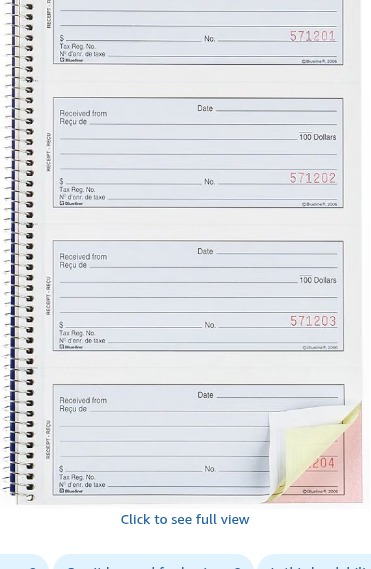
Blueline receipt book DC4084BT
Canadian brand
Ships from Amazon · Sold by Amazon.ca
100 numbered triplicates · EN/FR
Approx. CAD $19.85 at research time
Numbered, bilingual triplicate receipts for direct bookings and deposits.
Renting a cottage, condo or suite by the night in Ontario? Most stays of less than a month are taxable at 13% HST. Who collects it depends on whether you are registered: the platform for hosts who are not, and the host for hosts who are. Here is how CRA's rules work, with a worked example.
Estimate the HST on your rental income
Last reviewed October 2026 · Educational information, not tax advice.
GST/HST treats a rental by how long the same guest stays and what you charge per day. CRA's GST/HST Memorandum 19.2.2, Residential Real Property: Rentals and its page on platform-based short-term accommodation draw the lines this way:
| Type of stay | GST/HST treatment |
|---|---|
| Same guest stays less than one month, more than $20 per day | Short-term accommodation: taxable |
| Same guest has continuous occupancy for one month or more | Residential rent: exempt |
| $20 per day or less, any length of stay | Exempt |
So a cottage, condo or basement suite rented by the night or week on Airbnb, Vrbo or a similar site is usually taxable short-term accommodation. A unit rented to the same tenant for a month or longer is usually exempt, and you do not charge HST on that rent. Because the property is in Ontario, the place of supply is Ontario and the rate is 13% HST, whichever province your guests come from.
It depends on whether you are registered for GST/HST. CRA says an accommodation platform operator that facilitates taxable short-term stays for suppliers who are not registered is required to charge and collect the GST/HST on those stays. If you are registered, you continue to be required to charge and collect the tax yourself, including on stays booked through a platform.
| Your status | HST on the stay | What you do |
|---|---|---|
| Not registered (small supplier) | The platform charges and collects it | Nothing to remit for those stays |
| Registered for GST/HST | You charge and collect it | Give the platform your GST/HST number and report the HST on your return |
Airbnb’s help page for Canadian hosts says the same thing in practice: for hosts who are not registered it collects and remits the tax, and registered hosts need to provide their GST/HST number so Airbnb does not add tax on top of their price. The platform's own booking or service fee is a separate supply, and CRA says the platform charges HST on it at the rate where the property is located.
A host rents a Muskoka cottage for four nights at $180 a night, so the accommodation is $720.00. The place of supply is Ontario, so the HST is 13%:
| Line | Amount |
|---|---|
| Accommodation, 4 nights × $180 | $720.00 |
| HST (13%) | $93.60 |
| Total for the stay | $813.60 |
If the host is not registered, the platform charges the $93.60 and sends it to CRA. If the host is registered, the host charges the $93.60, reports it on their GST/HST return and remits it, and can generally claim input tax credits for the HST paid on expenses for the rental.
The usual small supplier rule applies. CRA's “When to register for and start charging the GST/HST” page says you are a small supplier, and do not have to register, if your taxable sales do not exceed $30,000 over four consecutive calendar quarters. Taxable short-term rentals count toward that total. Exempt long-term rents are not taxable supplies. Once you pass $30,000 you have to register, and you may choose to register voluntarily before then. Our guide to the $30,000 small supplier rule explains the timing in detail.
Registering is not only about charging tax. Rules for residential property, such as a change in how a home is used, can have their own GST/HST effects, so it is worth asking a qualified tax professional before you register for a rental you also live in.
Guests who book through a platform get the platform's receipt. If you also rent directly, CRA's charge and collect page says you must tell customers whether GST/HST applies and show the rate, either as a separate amount or with a clear statement that the price includes HST. A numbered, carbonless receipt book keeps a copy for your records and one for the guest.
Canadian brand
Ships from Amazon · Sold by Amazon.ca
100 numbered triplicates · EN/FR
Approx. CAD $19.85 at research time
Numbered, bilingual triplicate receipts for direct bookings and deposits.
As an Amazon Associate, HST Remit Lab may earn from qualifying purchases. Price and rating recorded at research time; check Amazon.ca for the current price. More options on the bookkeeping supplies page.
Only if you are registered for GST/HST. If you are not registered, CRA says the accommodation platform operator charges and collects the GST/HST on your taxable short-term stays. If you are registered, you charge and collect it yourself, including on stays booked through the platform.
Usually not. CRA treats a rental to the same individual for continuous occupancy of one month or more as exempt residential rent. Stays of less than one month at more than $20 per day are taxable short-term accommodation.
Yes. Taxable short-term rentals are taxable sales, so they count toward the $30,000 limit over four consecutive calendar quarters. Exempt long-term rents are not taxable supplies.
13% HST. The place of supply for short-term accommodation is where the property is located, so an Ontario property is taxed at the Ontario rate whichever province the guest lives in.
Rules and thresholds are taken from the CRA pages above. CRA can change them, so check the source before you rely on them.